
SEO Site Signals
AI Content Analysis
See how LLMs read your content—and why they skip it
Score priority pages for AI readiness, find the gaps and trust gaps that block citations, and download a JSON brief you can paste into ChatGPT, Claude, or Cursor to rewrite what’s wrong—using your own Grok, ChatGPT, or Gemini key for the run.
BYOK · homepage + up to 10 pages · content diagnostic, not a live score from every AI chat UI
The problem
Ranking on Google doesn’t mean LLMs will cite you
Assistants look for structured facts, topical completeness, and trust signals—not keyword density. A page can sit at #1 and still look empty to an LLM. Without a diagnostic, teams rewrite blindly or wait for traffic that never shows up in analytics.
- Prospects ask ChatGPT for a shortlist before they visit your site
- Thin claims, missing comparisons, and no author cues look untrustworthy to models
- You can pass classic SEO checks and still score poorly for citation readiness
What you get
Diagnostics you can act on
Five outputs every run—so the next edit is obvious, and your AI can help write it.
AI readiness scores
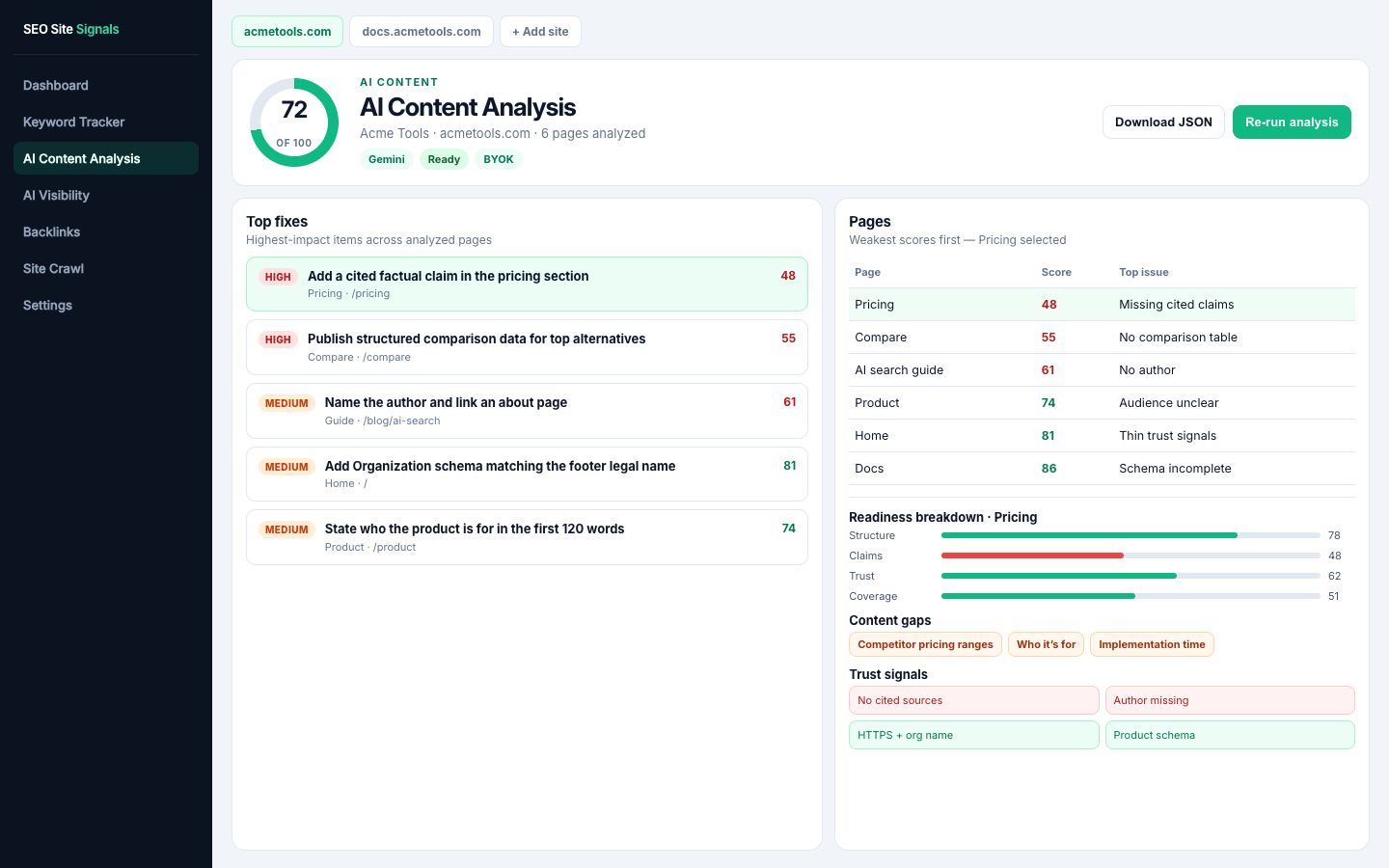
Each analyzed page gets a score with reasons—structure, claims, trust, and coverage—so you see which URLs look citation-ready and which get skipped.
Example: Pricing at 48 because claims and coverage fail, while Docs sits at 86.
Content gap analysis
Topics assistants expect in your category that your pages never cover, even when the prose otherwise looks polished.
Example: competitor ranges, who it’s for, and implementation time missing from /pricing.
Trust signal audit
Schema, sourcing, author cues, and factual specificity—what builds AI credibility and what quietly erodes it.
Example: product schema present, but no cited sources and no author on the money page.
Fix recommendations
Concrete edits ranked by impact in a fix-first list. Not “improve quality”—the next change to publish, then re-run.
Example: “Add a cited factual claim in the pricing section” before you touch meta titles.
JSON export for AI rewrites
Download the full diagnostic as JSON—scores, gaps, trust findings, and top fixes—and paste it into ChatGPT, Claude, Cursor, or your CMS AI so it rewrites the weak sections with the brief in context.
Example: “Here’s my AI Content Analysis JSON for /pricing—draft the missing comparison and trust blocks.”
Workflow
How a run works
Add your Assistant key
Use the same BYOK vault as AI Visibility—Grok, ChatGPT, or Gemini. We never burn a shared PositionMySite key on your analysis.
Analyze homepage + up to 10 pages
We crawl the site entry point and linked priority pages, then score each URL for how assistants are likely to read it.
Export JSON, fix with AI, re-run
Hit Download JSON, drop the file into the AI you already use for drafting, ship the edits, then re-run to see the readiness score move.
Who it is for
Teams already doing the SEO work
Built for people who already care about rankings—and now need AI answers too.
SaaS marketers
See why rivals win “best tools” answers while your product and pricing pages stay invisible to assistants.
Content-led companies
Export the JSON brief, hand it to your writing AI, and refresh money pages without auditing the whole CMS by hand.
E-commerce brands
Find product and category pages that under-explain what assistants need before they recommend you.
Growth agencies
Add AI content diagnostics next to classic SEO audits—clients get the dashboard; writers get the JSON.
Related
Pair it with the rest of the AI stack
Content Analysis diagnoses pages and exports JSON for your rewrite AI. AI Visibility measures whether assistants mention you. The free llms.txt check confirms crawlers can fetch you at all.
Your content looks great to Google. How does it look to ChatGPT?
Start a free trial, run AI Content Analysis, download the JSON, and let your AI help fix what the score flagged.