
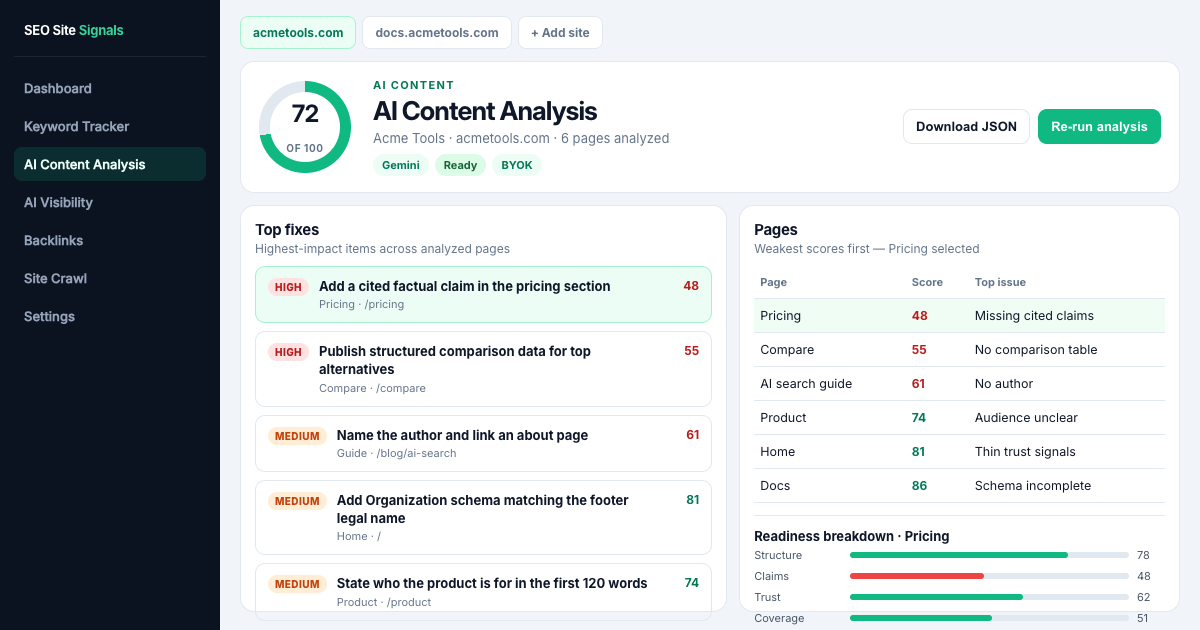
AI Content Analysis diagnoses whether your pages look citation-ready to large language models: readiness scores, content gaps, trust-signal issues, and specific fixes. Ranking on Google does not automatically mean ChatGPT, Gemini, or Grok will use your page as a source. Assistants lean on clear factual claims, topical completeness, structured data that matches the text, and author or publisher cues—not keyword density alone.
This guide explains what the four deliverables mean, how the SEO Site Signals tool runs (bring-your-own-key, homepage plus up to ten pages), and how it differs from AI Visibility, which measures whether assistants mention your brand in answers.
Why a #1 page can still score poorly for AI readiness
Search rankings reward relevance and links. Generative answers reward pages that state facts plainly, cover the comparison or pricing questions buyers ask, and look trustworthy enough to cite. A marketing homepage that ranks well can still read as thin, undated, or authorless to a model that is assembling a shortlist.
AI readiness scores
Each analyzed page gets a score based on structure, claims, and authority signals, with reasons for weak pages.
Content gap analysis
Missing topics that assistants expect in your category—often the real blocker when the prose otherwise looks fine.
Trust signal audit
Schema types, sourcing, author cues, and factual specificity that build or erode AI credibility.
Fix recommendations
Concrete edits ranked by impact in a fix-first list, not vague “improve quality” advice.
How SEO Site Signals runs the analysis
AI Content Analysis uses your Grok, ChatGPT, or Gemini key from the AI Visibility vault (BYOK). It crawls the site homepage and up to ten linked pages, then returns scores and fixes you can export as JSON. It is a content diagnostic—not a live score scraped from six consumer chat products at once.
- Add an Assistant key under AI Visibility.
- Open AI Content Analysis and run an analysis.
- Work the Top fixes list first, then re-run after you publish edits.
Diagnose content vs measure mentions
Use both products together. Content Analysis asks whether pages explain your offer clearly enough to be cited. Visibility asks whether ChatGPT, Gemini, and Grok actually name you on a fixed prompt set. If crawlers are blocked, fix that first with the free llms.txt & AI crawler access test.
- Low readiness, low mentions: rewrite priority pages, then keep measuring Visibility weekly.
- High readiness, low mentions: the page may be clear but third-party sources or prompt coverage still win—see the AI Visibility tracking guide.
- Mentions without citations: engines know the brand name but lean on other URLs—tighten claims and structured data on the pages you want cited.
AI Content Analysis FAQ
Is this the same as AI Visibility?
No. Visibility measures mentions and citations in assistant answers. Content Analysis scores how your pages are likely to be read and what to fix so they are easier to cite.
Do you score ChatGPT, Claude, and Perplexity live?
No. The diagnostic uses your chosen provider key to evaluate page content. That is honest BYOK analysis, not a claim that six consumer UIs returned the same score.
How many pages are analyzed?
The homepage plus up to ten linked pages per run—enough for priority money pages without pretending to audit thousands of URLs in one click.
Start with the feature overview: AI Content Analysis, then open the dashboard after you sign up. Pair it with AI Visibility when you are ready to measure mentions weekly.
SEO Site Signals is the audit and monitoring product from PositionMySite, with offices in Toronto and Tampa. The same team builds the free AI crawler checks and the BYOK AI dashboards described above.
Last updated: October 24, 2026 | Author: David Dayan