
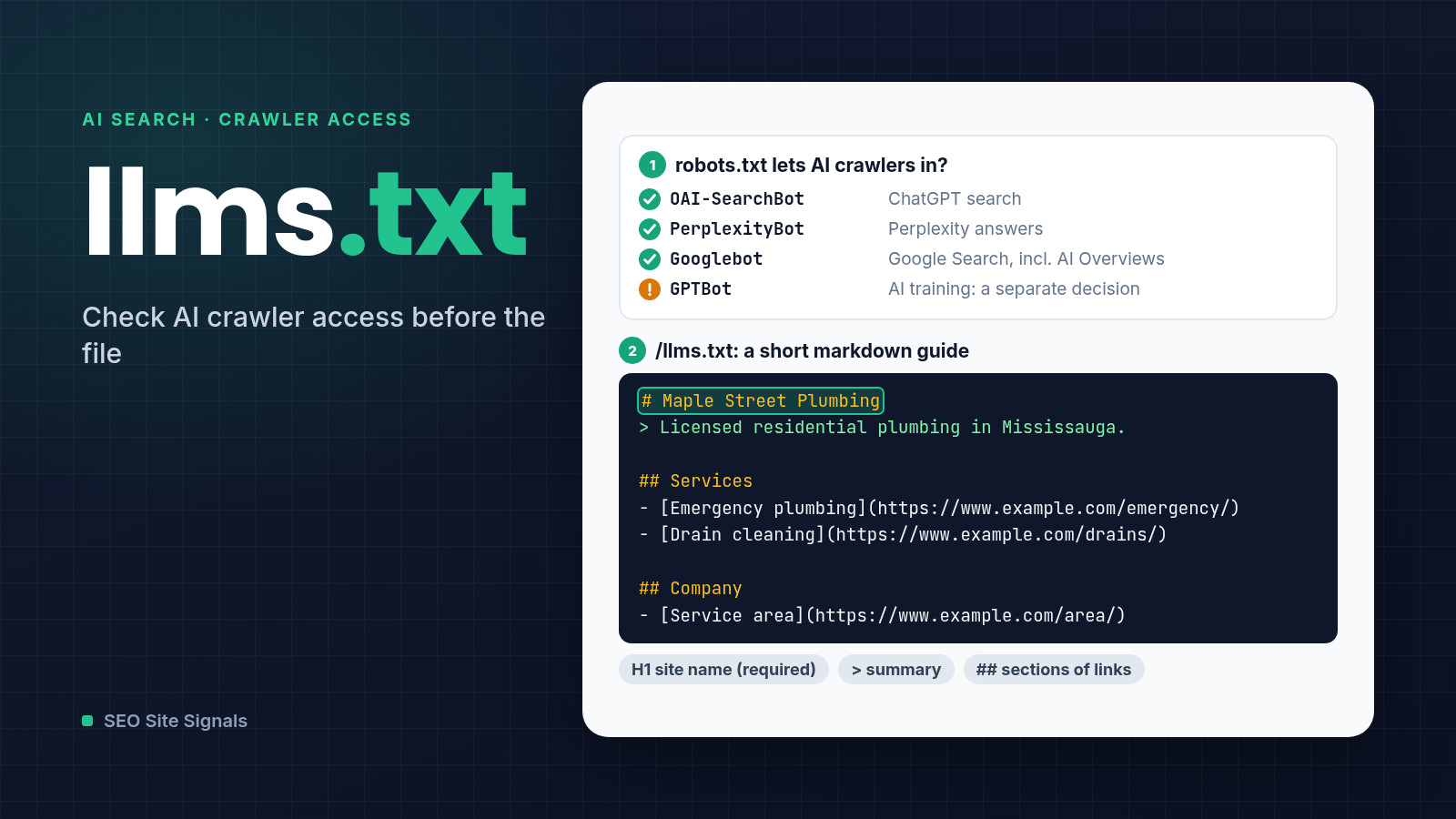
An llms.txt test should check two things in order: whether AI crawlers are allowed to fetch your pages at all, and only then whether you publish an /llms.txt file. Access comes first because llms.txt is a guide, not a permission. If robots.txt blocks OpenAI's search crawler or PerplexityBot, no markdown file will get you cited in those answers. The most common mistake we see is a copied "block all AI bots" snippet that blocks search crawlers along with the training ones.
This guide covers what llms.txt is and isn't, which crawlers control AI search visibility versus training, how to test your site, and what to put in the file.
What is llms.txt?
llms.txt is a proposed markdown file, placed at /llms.txt, that gives AI agents a short, curated guide to a website: what the site is and which pages hold the important information. Jeremy Howard published the proposal at llmstxt.org in September 2024 and released a revised version 2 in August 2026.
- Format: an H1 with the site name (the only required part), a short blockquote summary, optional notes, then H2 sections with lists of links.
- Purpose: help agents find the right pages quickly without parsing navigation, ads, and scripts.
- Not a robots rule: it doesn't allow or block anything. Crawling is still controlled by robots.txt.
Be realistic about its reach. Google's documentation on AI features says: "You don't need to create new machine readable files, AI text files, or markup to appear in these features." So llms.txt is optional, low-cost guidance for agents that choose to read it. It won't get you into AI Overviews.
Which AI crawlers control search visibility, and which control training?
Most AI companies now use separate user-agent tokens for search and for model training. Allowing the search crawlers and deciding separately about training is the split that matters for visibility.
OAI-SearchBot
Company: OpenAI
Used for: Showing sites in ChatGPT search answers
GPTBot
Company: OpenAI
Used for: Signalling whether content may be used to train OpenAI's models
ChatGPT-User
Company: OpenAI
Used for: Fetches made when a user asks ChatGPT to visit a page
PerplexityBot
Company: Perplexity
Used for: Indexing for Perplexity's answers
Googlebot
Company: Google
Used for: Google Search, including AI Overviews and AI Mode
Google-Extended
Company: Google
Used for: Gemini model training and grounding in Gemini Apps and Vertex AI; not used for Search ranking
ClaudeBot
Company: Anthropic
Used for: Collecting content for Anthropic's models
CCBot
Company: Common Crawl
Used for: An open web dataset widely used for AI training
OpenAI's crawler documentation states that sites opted out of OAI-SearchBot won't be shown in ChatGPT search answers, and that each setting is independent. You can allow OAI-SearchBot and disallow GPTBot. Blocking GPTBot on its own doesn't remove you from ChatGPT search.
How do you test AI crawler access and llms.txt?
Test AI access by reading your live robots.txt the way each AI user agent would, including the default User-agent: * group, and then requesting /llms.txt from the domain root. Run it on production, because staging robots files are often deliberately closed.
- Paste your domain into the llms.txt & AI Crawler Access Test. It reports which major AI crawlers your robots.txt allows or blocks and whether an
/llms.txtfile exists. - If a search crawler you want (OAI-SearchBot, PerplexityBot, Googlebot) is blocked, fix that first. Nothing else matters until it can reach the page.
- Check the
User-agent: *group. A leftoverDisallow: /blocks every crawler without a more specific group of its own. - Decide on training tokens (GPTBot, Google-Extended, ClaudeBot, CCBot) as a separate policy question.
- Re-run the test after changing robots.txt. CDNs sometimes cache the old file.
What should an llms.txt file contain for a small business?
A useful llms.txt for a small business is short: your name, a one- or two-sentence summary, and links to the ten or so pages you would want an AI answer to cite, each with a one-line note. Keep it current. A map that points to deleted or redirected pages is worse than none.
# Maple Street Plumbing

> Licensed residential plumbing in Mississauga and west Toronto. 24/7 emergency service.

## Services
- [Emergency plumbing](https://www.example.com/emergency/): 24/7 call-outs, typical response times
- [Drain cleaning](https://www.example.com/drains/): methods, pricing ranges

## Company
- [Service area](https://www.example.com/areas/): cities and postal codes covered
- [Licences and insurance](https://www.example.com/about/): licence numbers, warranty terms
Link only to pages that are indexable and return HTTP 200. If a listed page carries a noindex tag or redirects, fix that first.
Why did this become more urgent in August 2026?
On August 19, 2026, Google announced that generative UI, which builds interactive tools, visuals, and simulations on the results page, had launched globally in English in AI Mode and started rolling out in AI Overviews. Search can now assemble a calculator or comparison on the results page instead of sending the click to a site that used to provide it.
These surfaces still draw on source pages. For Google, that means pages Googlebot can crawl and index. For ChatGPT and Perplexity, it means pages their search crawlers can reach. That is why the access half of this test matters more than the file.
What if access is fine and you still aren't cited?
If the crawlers are allowed and you still don't appear in AI answers, the problem is content and clarity, not access. AI answers tend to cite pages that answer a specific question directly, name the entity clearly, and match structured data to visible text. Checking your markup with the Schema Markup Test is a sensible next step. The AI visibility tracking guide covers how to measure whether you are mentioned at all.
llms.txt FAQ
Does Google use llms.txt?
Google's documentation on AI features says you don't need to create new machine-readable files, AI text files, or markup to appear in AI Overviews or AI Mode. Google Search relies on Googlebot crawling and its normal index. An llms.txt file is optional guidance for agents that choose to read it.
Is llms.txt the same as robots.txt?
No. robots.txt tells crawlers what they may fetch. llms.txt is a markdown guide describing your site and its important pages. It grants no permissions and blocks nothing. If robots.txt blocks a crawler, an llms.txt file won't change that.
Does blocking GPTBot remove my site from ChatGPT?
Not from ChatGPT search. OpenAI says GPTBot relates to model training, while OAI-SearchBot decides whether sites appear in ChatGPT search answers, and the settings are independent. To stay visible in ChatGPT search, allow OAI-SearchBot even if you disallow GPTBot.
Should I block AI training crawlers?
It is a business decision, not an SEO requirement. Some businesses block training tokens to keep control of their content. Others allow them so AI tools describe their products accurately. Whatever you choose, keep search crawlers such as Googlebot, OAI-SearchBot, and PerplexityBot allowed if you want to appear in those answers.
Where should llms.txt live?
Put it at the root of your domain as /llms.txt, served as plain text with HTTP 200. Version 2 of the proposal also allows files at subpaths, such as /docs/llms.txt, which cover the pages under that path.
Check access before you write the file: run your domain through the llms.txt & AI Crawler Access Test and unblock any search crawler you want citations from.
PositionMySite builds SEO Site Signals, the free-tool and monitoring product on this site. We are a North American software company in Toronto and Tampa, working on the web since 2009, and our engineers build the AI-readiness checks, including this llms.txt test, in-house alongside the paid dashboard. The single checks stay free so small teams can see whether AI search can even reach them before spending on anything else.
Last updated: September 25, 2026 | Author: David Dayan | Sources: llmstxt.org, "The /llms.txt file" (Jeremy Howard); Google Search Central, "AI features and your website"; OpenAI, "Overview of OpenAI Crawlers"; Google, "Google's common crawlers"; Google, "5 new ways to level up your learning with Search" (August 19, 2026).