
SEO for AI is mostly the SEO you already know: pages that search engines can crawl, index, and understand, with clear answers written for people. Google's own guide says "optimizing for generative AI search is optimizing for the search experience, and thus still SEO." Ikea, Debenhams, and DoorDash told Google the same thing in August 2026. Skip the gimmicks, follow the setup order below, and measure what happens.
What did Ikea, Debenhams, and DoorDash say about SEO and AI?
In an August 2026 Think with Google conversation, Google framed it plainly: "The best formula for success remains foundational search engine optimization (SEO)." The section heading read "Good SEO is good GEO." The three companies described longer, more conversational searches and the same response:
- DoorDash (Andy Wells, VP of growth marketing): saw "27% longer search queries year over year," within traditional Search, not only AI Mode. He called it a misconception that answer engine optimization is "entirely new" and separate from SEO. DoorDash kept focusing on "site architecture, structured data, and ensuring that best practices are in place so that crawlers can read our site," across more than 500,000 product SKUs.
- Debenhams (Dan Finley, group CEO): sees customers finding the retailer "through extended search terms," and is responding with richer, deeper content and more relevant imagery.
- Ikea (Linda Ha, deputy CMO): described building "an integrated search foundation" that allows for local differences, then building on it.
Google also reported that the average AI Mode search is about three times the length of a traditional query, based on Trends data from May 2025 to April 2026.
What does Google say you do not need to do for AI search?
Google's page "Optimizing your website for generative AI features on Google Search" has a mythbusting section on what you can ignore for Google Search. Its list, in Google's words where quoted:
llms.txt and other "special" files
What Google says: You don't need "new machine readable files, AI text files, markup, or Markdown" to appear in Google Search, including its generative AI features, because Google Search doesn't use them.
The nuance: Creating an llms.txt file for other services is fine. Google says it will "neither harm nor help" your visibility in Google Search.
"Chunking" your content
What Google says: There is no requirement to break content into tiny pieces. Its systems can understand multiple topics on a page, and "there's no ideal page length."
Rewriting content just for AI systems
What Google says: You don't need to write in a specific way for generative AI search. The systems understand synonyms and general meaning, so you don't need every long-tail variation.
Chasing inauthentic "mentions"
What Google says: Seeking inauthentic mentions across the web "isn't as helpful as it might seem." Core ranking systems focus on high-quality content, and other systems block spam.
Overfocusing on structured data
What Google says: Structured data isn't required for generative AI search, and there is no special schema.org markup to add. It still helps with rich result eligibility, so keep using it.
What Google says does matter: a page must be indexed and eligible to show in Search with a snippet, and your content must be crawlable. Unique, non-commodity content, it says, will likely influence your presence in generative AI search "in the long run more than any of the other suggestions in this guide." It also warns that no third-party tool has access to Google's internal ranking or AI systems, so judge any tool's advice, ours included, against Google's own guidance. For local and shop sites, it also points to keeping Merchant Center and Business Profile details current, because AI responses can include product listings and local business information.
That advice covers Google Search only. Other assistants run their own crawlers, so check their access separately (step 1 below).
How to SEO for AI: what order should you work in?
Work from access to answers to measurement. Each step links to the page that owns the detail.
- Allow crawling. Make sure robots.txt, your CDN, and your host let in the search crawlers you care about; Google lists CDN and hosting blocks alongside robots.txt. Separate search from training crawlers with the robots.txt checker guide, then run the AI crawler access test.
- Make the page indexable. No stray noindex or nosnippet, canonicals pointing to the right URL, and the page in your XML sitemap. In Search Console, confirm the Search generative AI control is still on its default, which includes your site.
- Write clear answer pages. One page per real question or service, the answer in the first sentences, and key facts such as prices, hours, service areas, and policies as text rather than images or PDFs. Clear headings and short sections help readers, and Google notes that high-quality images and video can give your page more ways to appear.
- Match structured data to the visible text. No special schema is needed. Run the page through the Schema Markup Test and fix anything the page doesn't actually say.
- Add llms.txt only if you want it. Google ignores it, so it is optional. If other services you care about read it, the llms.txt test guide shows what a small file contains.
- Measure. Google points site owners to the Generative AI performance report in Search Console. For whether ChatGPT and Gemini mention you, follow the AI visibility tracking guide; paid monitoring can run those checks, with a 3-day free trial. To set up AI referral tracking step by step, see our guide to tracking AI search traffic in GA4 and Search Console.
How do you audit foundational SEO by template?
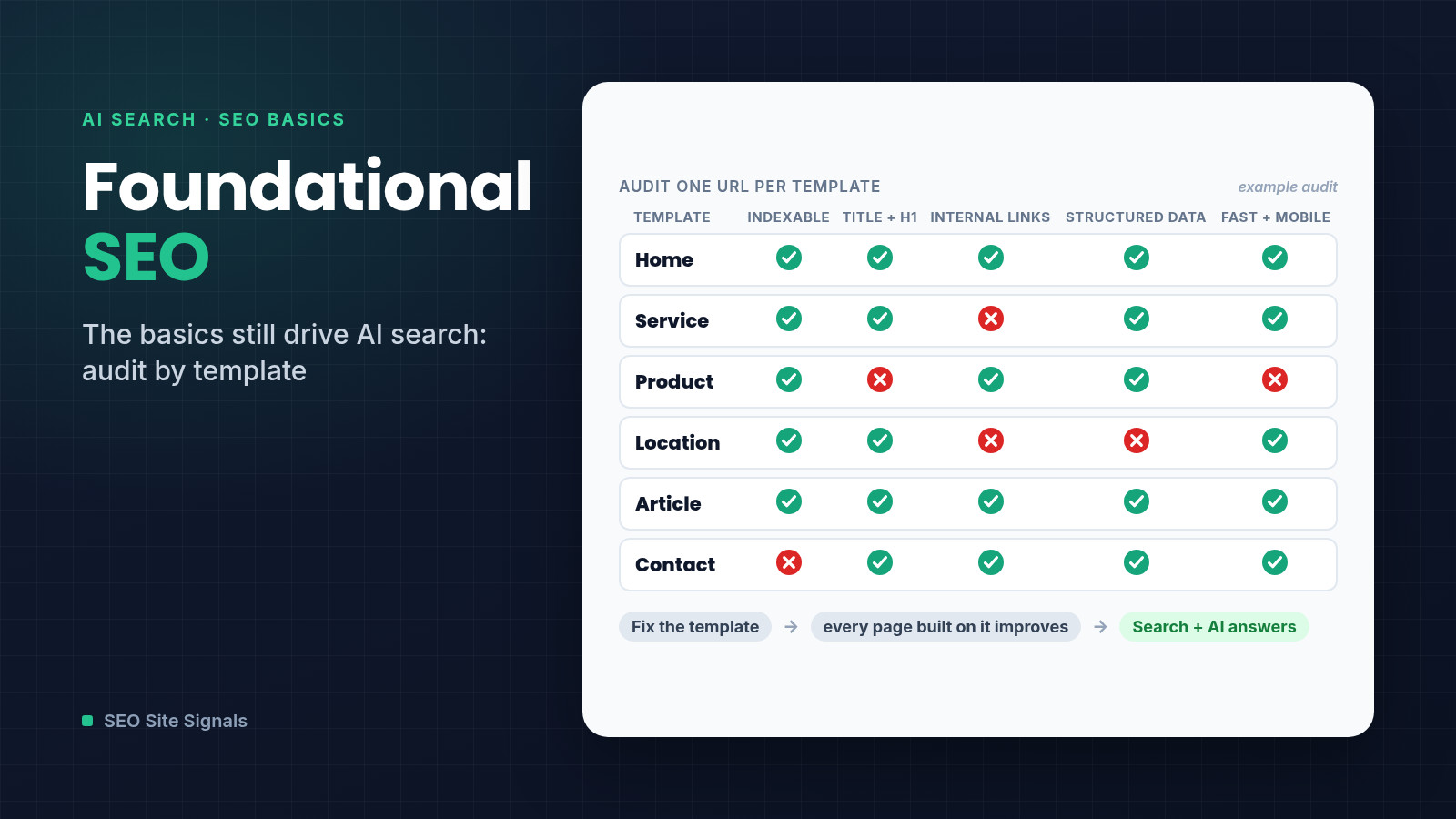
Most small-business sites have five or six templates (home, service or category, product, location, article, and contact), and a problem in a template repeats on every page built from it. Check one live URL per template against these basics:
Indexability
Good: No stray noindex; canonicals point to the right URL
Check: No-Index Checker, Canonical URL Test
Architecture
Good: Important pages within a few clicks of the homepage and in the XML sitemap
Check: XML Sitemap Checker
Titles and headings
Good: One clear H1; a unique, descriptive title per page
Structured data
Good: Markup that matches the visible text (products, business details, articles)
Check: Schema Markup Test
Run each URL through Instant Analysis, the free scan on our homepage. It runs 80+ checks, including AI readiness, with no signup. Fix blockers first (noindex, robots blocks, broken canonicals, redirect chains, missing titles), then clarity, and re-test after each deploy. A single-URL scan won't find a broken link three levels deep; that needs a crawl. For error pages, the soft 404 guide shows how to confirm the right status code.
How should you write for longer, conversational queries?
Longer queries reward pages that match a real situation. DoorDash's example was "best gig delivery jobs in San Jose," not "find a job." Google says you don't need to write in a special way for AI, so the goal is specificity for readers, not keyword variants:
- Service pages that name the problem, the location, and who it is for.
- Question-shaped headings with a direct answer in the first sentence or two below them.
- Images that show the real product or work, with descriptive alt text.
SEO for AI FAQ
How do SEO and AI search relate?
SEO for AI is regular SEO applied to AI search. Google says its generative AI features are rooted in its core Search ranking and quality systems, so the same basics apply: crawlable, indexed, useful pages. There are no extra technical requirements beyond being indexed and eligible to show a snippet.
Is GEO different from SEO?
Generative engine optimization (GEO) describes efforts to appear in AI-generated answers. Google's guide says that from its perspective, optimizing for generative AI search is optimizing for the search experience, and thus still SEO. DoorDash called treating it as an entirely separate practice a misconception.
Do I need llms.txt or special markup for AI Overviews?
No. Google says you don't need new machine readable files, AI text files, or special markup to appear in AI Overviews or AI Mode, and Google Search ignores llms.txt. The page needs to be indexed and eligible to show a snippet, like any other Search result.
Does structured data help AI search?
Structured data helps search engines understand a page, and Google recommends that it match the visible text. Google says no special schema is required for AI features, so treat it as part of a clear, accurate page, not a shortcut into AI answers.
How often should I audit foundational SEO?
Audit your main templates after every theme update, plugin change, migration, or redesign, and at least quarterly otherwise. Template changes affect many pages at once, so a quick check after each release catches most problems before they cost traffic.
Try this today: paste one URL from each template into Instant Analysis on the homepage and fix the blockers before you touch the copy. You can also pick single checks from the free tools list.
SEO Site Signals is the free-tool and site-audit product from PositionMySite, a software company based in Toronto and Tampa since 2009. Our in-house team builds the single-URL checks, the AI-readiness tests, and the paid monitoring dashboard. We keep the one-off checks free so a small business can audit its own foundation before paying for anything.
Last updated: October 9, 2026 | Author: David Dayan | Sources: Google Search Central, "Optimizing your website for generative AI features on Google Search"; Think with Google, "Growth lessons from Ikea, Debenhams, and DoorDash for the AI Search era" (August 2026); Google Search Central, "AI features and your website"; Search Console Help, "Search generative AI control"; Google Search Central, "SEO Starter Guide"; Google Search Central, "Introduction to structured data markup".