
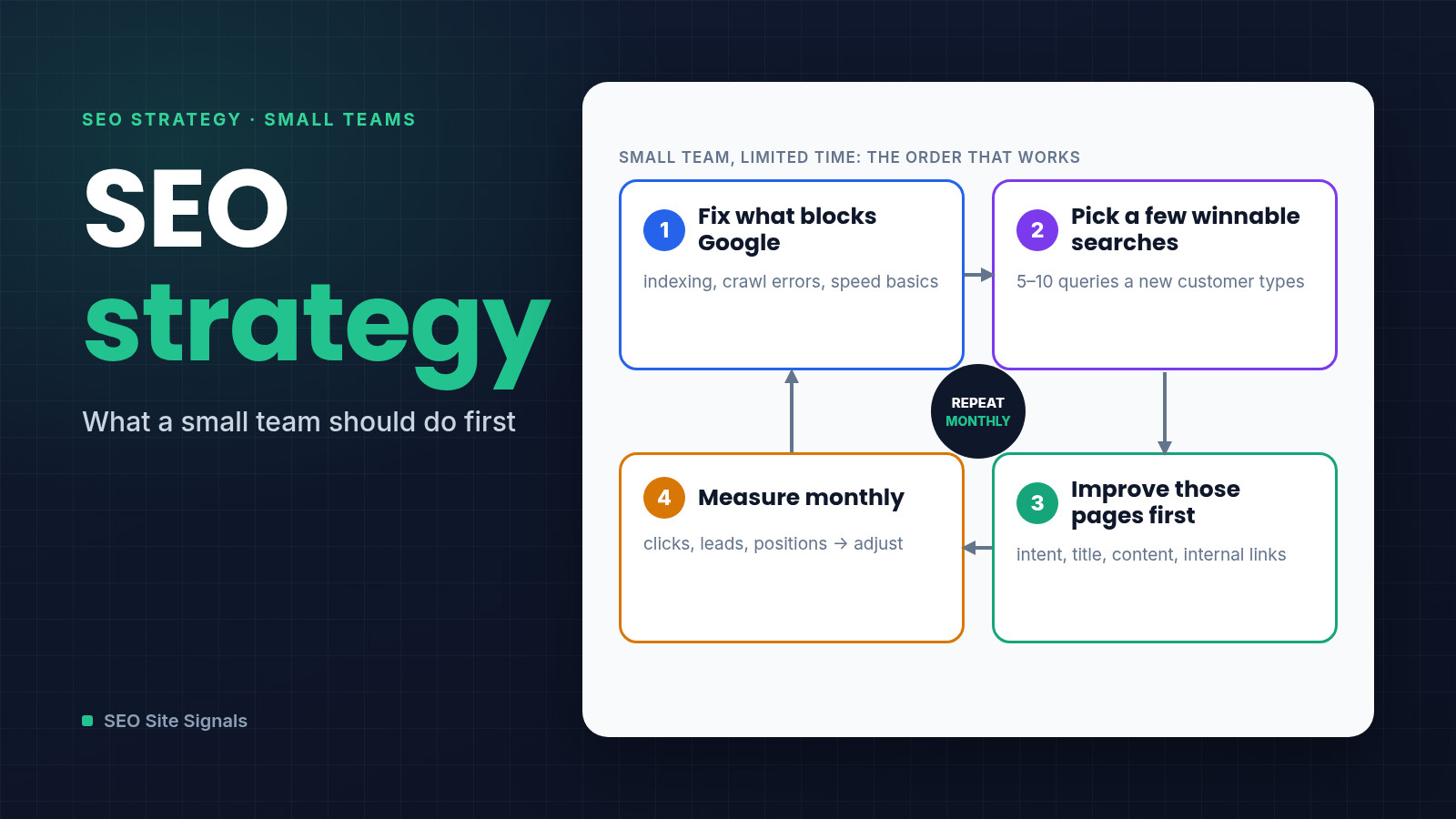
A small team's SEO strategy should follow one order: fix anything that stops Google crawling and indexing your important pages, choose a short list of searches you can realistically win, make the pages for those searches the best answer available, then earn links and mentions and measure the results monthly. Most small businesses don't need a bigger plan. They need to stop spreading limited hours across too many pages and tactics at once.
This guide lays out that strategy as a sequence, with what to check at each stage and roughly how much effort it takes.
What should a small team fix before anything else?
Start with anything that stops Google finding or indexing your key pages. No content or link work pays off while those barriers exist.
- Set up Google Search Console and check the Page indexing report for your main pages.
- Confirm robots.txt isn't blocking important sections and no stray noindex is excluding pages.
- Make sure one version of the site (https, with or without www) is canonical and the others redirect to it.
- Submit an XML sitemap listing only the pages you want indexed, and confirm it parses with the XML Sitemap Checker.
The crawling and indexing checklist walks through each of these.
How do you choose which searches to target?
Pick searches where you have a real chance and a real business reason. A small team does better owning 10 relevant searches than chasing 200.
- Start from what you sell. List your main services or products and the words customers use for them.
- Check what already works. In Search Console, find queries where you already get impressions in positions 5 to 20. Those are the fastest wins.
- Look at who ranks. If page one is national brands and directories, target a more specific version: a service plus your city, a specific problem, or a comparison.
- Match intent. Decide whether each search needs a service page, a guide, or a local page, based on what already ranks.
What does a realistic monthly plan look like?
Month 1
Work: Fix indexing and technical blockers, set up Search Console and GA4, pick target searches
Typical effort: A few days
Months 2 to 3
Work: Improve the existing pages that match your target searches: titles, answers, proof, calls to action
Typical effort: 1 to 2 pages a week
Months 3 to 6
Work: Create missing pages for important searches, build internal links, start earning local links and reviews
Typical effort: 2 to 4 pages a month
Ongoing
Work: Monthly review of rankings, clicks, and leads; update what slips
Typical effort: A few hours a month
The exact pace depends on your team. What matters is that each month has one clear priority.
Should you improve existing pages or write new ones?
Improve existing pages first. A page Google already shows has been judged relevant, so better titles, clearer answers, and stronger proof often produce results sooner than a new page would. Write new pages when a target search has no matching page at all.
For the process of improving a single page, see the content optimization guide.
How much technical SEO does a small site need?
Less than tool reports suggest. After indexing is fixed, focus on issues that affect real visitors or key pages: slow mobile loading, broken pages, redirect chains, missing titles, and duplicate content. Many warnings in audit tools are low priority. Fix the ones on the pages that earn traffic and leads, and ignore the noise.
A reasonable routine is a monthly scan of your top pages. The free SEO tools index lets you run individual checks, such as speed, titles, schema, and redirects, when you only need one answer.
How do small businesses earn links without a big budget?
- Get listed with suppliers, manufacturers, and industry associations you already work with.
- Take part in local events, sponsorships, and community groups that link to members.
- Publish something genuinely useful: a price guide, a local resource, or a tool customers need.
- Offer expert comment to local media on topics you know well.
Avoid buying links or joining link schemes. Google's spam policies prohibit links intended to manipulate rankings, and the risk isn't worth it for a business that depends on its site.
How do you measure whether the strategy works?
Review the same few numbers every month:
- Search Console: clicks and impressions for your target pages and queries, and average position.
- GA4: key events, such as form submissions, calls, and purchases, from organic search.
- Your business: leads and sales you can trace to organic search.
Compare with the same month last year where possible, to allow for seasonality. If you want rankings tracked for you, SEO Site Signals plans start at $19.99 a month for 50 tracked keywords, with nightly rank updates.
SEO strategy FAQ
How long does SEO take for a small business?
Fixing technical blockers and improving existing pages can show results in weeks to a few months, once Google recrawls them. Competitive searches and new pages usually take longer. There is no guaranteed timeline, and anyone promising specific rankings by a date is guessing.
Should a small business do SEO in-house or hire someone?
Many small teams can handle the basics themselves: Search Console, page improvements, reviews, and local listings. Consider outside help for complex technical work, migrations, or when you don't have the time. Either way, understand the plan well enough to judge the work.
How many keywords should a small business target?
Start with a short list, often 10 to 30 searches tied to your main services and locations. It's better to rank well for a few searches that bring customers than to rank poorly for hundreds. Expand once those pages perform.
Is blogging necessary for SEO?
Not always. Many local service businesses do well with strong service and location pages. Blog posts help when customers search for questions and guides related to what you sell. Write them to answer real questions, not to hit a posting schedule.
What is the most common SEO mistake small businesses make?
Trying to do everything at once. Spreading effort across many tactics, pages, and keywords usually means none gets enough attention. Fix indexing first, focus on a few searches, and finish each piece of work before starting the next.
Pick the checks that match this month's priority: browse the SEO Site Signals tools and run only the ones your plan calls for, whether that's indexing, titles, speed, or schema.
We're PositionMySite, based in Toronto and Tampa and building for the web since 2009. SEO Site Signals is our in-house product for small and mid-size businesses: free one-off checks, plus monitoring for teams that want their plan tracked without an enterprise tool bill.
Last updated: September 25, 2026 | Author: David Dayan | Sources: Google Search Central, "SEO Starter Guide"; Google Search Central, "Do you need an SEO?"; Google Search Central, "Spam policies" (link spam); Search Console Help, "Performance report (Search results)"; SEO Site Signals plans.