
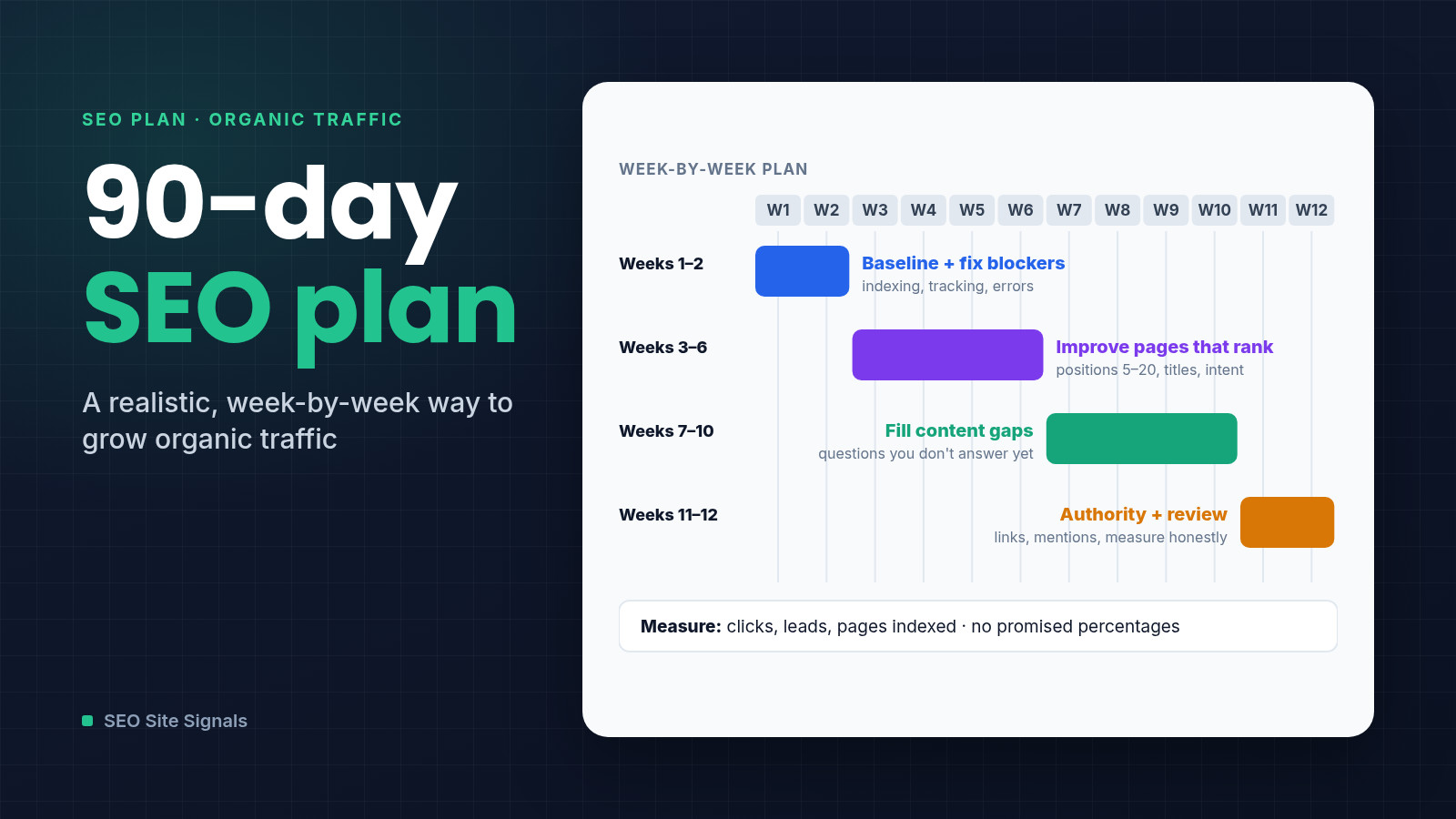
You can grow organic traffic in 90 days by working in a fixed order: spend the first two weeks fixing what stops Google indexing your key pages, the next month improving pages that already appear in search, and the final weeks filling clear content gaps and earning a few links. What you can't do honestly is promise a number. This post used to carry a "300%" headline. Results depend on your starting point, competition, and seasonality, so treat any fixed percentage as marketing, not a plan.
Here is the 90-day plan, week by week, with what to measure so you know whether it worked.
What can you realistically expect in 90 days?
Ninety days is enough time to remove technical barriers, improve the pages Google already shows, and publish a handful of strong new pages. It's usually not enough to rank a new site for competitive terms or to see the full effect of new content and links, which Google needs time to crawl, index, and assess.
- Likely within 90 days: more pages indexed, better click-through rates from improved titles, and gains for pages that were already ranking on page two.
- Possible but not guaranteed: new pages ranking for less competitive, specific searches.
- Usually takes longer: competitive head terms, and results from link building.
Big percentage jumps happen most often when a site was badly broken, for example by a site-wide noindex, and the fix restores traffic. That's recovery, not a growth formula.
Weeks 1 to 2: How do you set a baseline and fix blockers?
- Record a baseline. Export the last three months from Search Console (clicks, impressions, queries, pages) and organic key events from GA4. Note the same period last year for seasonality.
- Check indexing. Review the Page indexing report and inspect your ten most important URLs. Fix noindex, robots.txt, and canonical problems first.
- Run a full scan of your key pages. The All-in-One SEO Test checks 80-plus signals on a page and ranks fixes by impact.
- Fix broken pages and redirects. Missing pages should return a real 404 or redirect to a relevant replacement.
Weeks 3 to 6: Which pages should you improve first?
Improve pages that already have impressions, because Google already considers them relevant. In Search Console, filter for pages with many impressions and a low click-through rate, or queries in positions 5 to 20.
High impressions, low CTR
Likely fix: Rewrite the title and meta description to match the query and stand out
Positions 5 to 20
Likely fix: Answer the query earlier, cover follow-up questions, add proof and detail
Several pages for one query
Likely fix: Merge or differentiate so one page is clearly the answer
Traffic but no leads
Likely fix: Add a clear next step and trust signals near it
Aim for one or two page improvements a week. The content optimization guide has the process for each page.
Weeks 7 to 10: What new content should you create?
Create new pages only for searches that matter to your business and have no good page on your site yet. Good candidates come from:
- Search Console queries where you appear but no page really answers the question.
- Questions customers ask in emails, calls, and sales meetings.
- Services or locations you offer that don't have their own page.
A few thorough pages beat many thin ones. Link each new page from related existing pages so Google finds it quickly, and add it to your sitemap.
Weeks 11 to 12: How do you build authority and review results?
- Ask partners, suppliers, and associations you work with to list or link to you.
- Ask recent customers for reviews if you serve a local area.
- Compare the last four weeks with your baseline and with the same period last year.
- Split results into brand and non-brand queries. Non-brand growth is the better sign that SEO work is paying off.
- Decide what to repeat in the next 90 days.
What should you not do in a 90-day push?
- Publish large volumes of thin or AI-spun pages. Google's spam policies cover scaled content abuse, whatever tool produces it.
- Buy links. Links meant to manipulate rankings break Google's spam policies.
- Change everything at once. You won't know what worked. Keep a dated log of changes.
- Judge results after a week. Google needs time to recrawl and reassess changed pages.
For how to judge growth claims, including your own, see how to check a "300% in 90 days" claim. For a longer-term plan, see SEO strategy for a small team.
90-day SEO plan FAQ
Can you really grow organic traffic 300% in 90 days?
Sometimes, from a very low or broken starting point, but it can't be promised. Growth depends on your baseline, competition, seasonality, and how much was wrong to begin with. Treat any guaranteed percentage with suspicion and measure against your own baseline instead.
What is the fastest SEO win for most small sites?
Fixing indexing problems and improving titles on pages that already get impressions. Both work on pages Google already knows. A stray noindex or a weak title on a high-impression page is often worth more than a month of new content.
How many blog posts should I publish in 90 days?
There's no required number. Publish pages for real searches that matter to your business and that your site doesn't answer yet. A handful of thorough pages usually beats a large batch of thin ones.
Should I track rankings or traffic?
Both, plus leads. Rankings show movement on specific searches. Clicks from Search Console show whether that movement brings visitors. Key events in GA4 show whether those visitors matter to the business.
What if nothing improves after 90 days?
Check that changes were indexed, that you picked searches you can realistically win, and that your pages match what ranks. Also check for Google updates and seasonal dips. Then adjust the target list rather than abandoning the plan.
Track the 90 days, not just day one: SEO Site Signals monitoring plans start at $19.99 a month for 50 tracked keywords with nightly rank updates, and include a 3-day trial, so you can see whether each week's work moves anything.
PositionMySite has been building websites and software in Toronto and Tampa since 2009. Our in-house team built SEO Site Signals to give small and mid-size businesses honest, measurable SEO checks, which is why this plan promises a process rather than a percentage.
Last updated: September 25, 2026 | Author: David Dayan | Sources: Google Search Central, "SEO Starter Guide"; Search Console Help, "Page indexing report"; Search Console Help, "Performance report (Search results)"; Google Search Central, "Spam policies".