
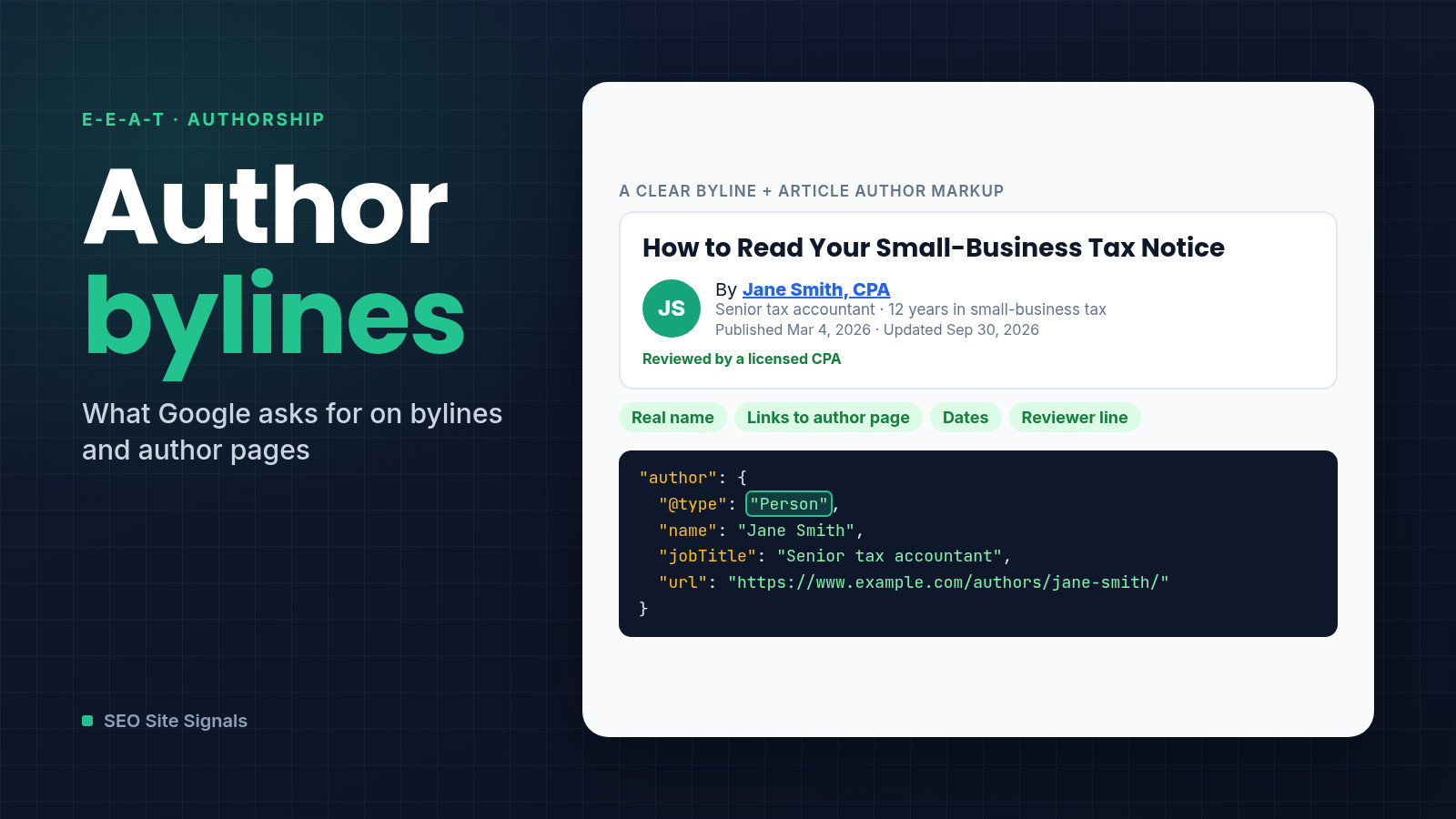
Google recommends that pages carry a byline where readers would expect one, that bylines lead to more information about the author, and that Article structured data names the same author with a link to their page. Google also says E-E-A-T itself isn't a specific ranking factor. Clear authorship doesn't boost rankings on its own. It helps readers and Google's systems judge whether the content is trustworthy, which matters most for health, money, and safety topics.
This guide covers what Google has actually published about authorship and turns it into a checklist for a small business blog.
What does Google say about authorship?
Google's guidance on helpful content suggests evaluating content by "Who, How, and Why." The "Who" questions are about authorship:
- Is it self-evident to visitors who authored the content?
- Do pages carry a byline where one might be expected?
- Do bylines lead to more information about the author, including their background and the areas they write about?
Google says it strongly encourages adding accurate authorship information, such as bylines, to content where readers might expect it. The emphasis is on accurate. Invented authors or inflated credentials work against you.
Is E-E-A-T a ranking factor?
No, not directly. E-E-A-T stands for experience, expertise, authoritativeness, and trustworthiness. It comes from Google's search quality rater guidelines. Google says E-E-A-T itself isn't a specific ranking factor, but its systems use a mix of factors that can identify content with good E-E-A-T, and give more weight to those signals for "Your Money or Your Life" topics.
For a small business, that means authorship is part of a bigger picture. A byline won't rescue thin content, but a clear author with real experience makes good content easier to trust.
What should a good byline include?
- The real name of the person who wrote or substantially edited the piece, or the business name for team content.
- A link to an author page rather than a plain text name.
- A visible date, and an updated date when you change the content meaningfully.
- A reviewer line where relevant, for example "Reviewed by a licensed electrician," if that review really happened.
Place the byline near the title, where readers look for it. Avoid hiding it at the bottom of the page or in an image.
What belongs on an author page?
An author page answers the reader's question: why should I trust this person on this topic? Keep it factual.
- Name, photo, and role at the business.
- Relevant experience: years in the trade, certifications, licences, the kinds of jobs they do. Only list what you can back up.
- Topics they write about, and a list of their articles.
- Links to profiles elsewhere, such as a professional association listing or LinkedIn.
For a one-person business, the About page can serve as the author page. Link bylines to it.
How do you mark up authors in structured data?
Google's Article structured data documentation lists author markup best practices:
Include every author shown on the page
Example: All visible bylines appear in the markup
Give each author their own entry
Example: "author": [{"name": "A"}, {"name": "B"}], not one combined name
Add @type and url or sameAs
Example: {"@type": "Person", "name": "...", "url": "https://example.com/about/"}
Put only the name in author.name
Example: No job titles, publisher names, or "Posted by"
Use Organization for business-authored content
Example: {"@type": "Organization", "name": "...", "url": "https://example.com/"}
Keep the visible byline, the author page, and the markup consistent. The same person should appear in all three. Check the markup with the Schema Markup Test, which reads the JSON-LD and microdata on the page.
How does authorship relate to AI search?
Google says the same SEO best practices apply to AI features such as AI Overviews, with no special requirements. Clear authorship is part of that. Other AI assistants also use web pages as sources, and a page that clearly states who wrote it and why they know the topic is easier to present as a credible source. For more on AI visibility, see the AI visibility tracking guide.
What authorship mistakes should you avoid?
- Fake or stock-photo authors: they undermine trust if discovered and contradict Google's call for accurate authorship.
- "Admin" or "Team" bylines everywhere: fine for news updates, weak for expert advice.
- Author pages with no substance: a name and a single line add little.
- Markup that doesn't match the page: a Person in the JSON-LD and a different name in the visible byline.
- Claiming reviews that didn't happen: a "medically reviewed" or "expert reviewed" line must be true.
Authorship FAQ
Do author bylines improve Google rankings?
Not directly. Google hasn't described bylines as a ranking factor, and says E-E-A-T itself isn't one. It does strongly encourage accurate authorship information because it helps people judge content. Treat bylines as part of making content trustworthy, not as a ranking switch.
Should small business blogs use a person or the company as author?
Use a person when a specific individual wrote or reviewed the content and their experience matters, such as a licensed tradesperson or accountant. Use the organization for general company news. Google's Article markup supports both Person and Organization authors.
Can I use AI to write content with a human byline?
Google's guidance asks how content was created and suggests explaining automation where readers would reasonably expect it. If a person substantially edits, fact-checks, and stands behind the content, a byline can be accurate. A byline on unreviewed AI output misrepresents who created it.
Is Google authorship markup (rel=author) still used?
No. Google ended its old authorship program with author photos in search results in 2014, and rel=author links aren't used for that. Use a visible byline, an author page, and the author property in Article structured data instead.
What if my content is written by several people?
List each author in the visible byline and give each their own entry in the author markup. Google's documentation specifically says not to merge several names into one author field.
Check that your byline and markup agree: run a blog post through the free Schema Markup Test and confirm the Article markup names the same author as the visible byline, with a working link to their page.
PositionMySite is a Toronto and Tampa software company that has been building for the web since 2009. SEO Site Signals is the free-tool side of what we do, built in-house for small and mid-size businesses. Every post on this blog carries a real byline for the same reasons this guide describes.
Last updated: September 25, 2026 | Author: David Dayan | Sources: Google Search Central, "Creating helpful, reliable, people-first content"; Google Search Central, "Article structured data" (author markup best practices); Google Search Central, "AI features and your website"; Google, "Search Quality Rater Guidelines" (PDF).