
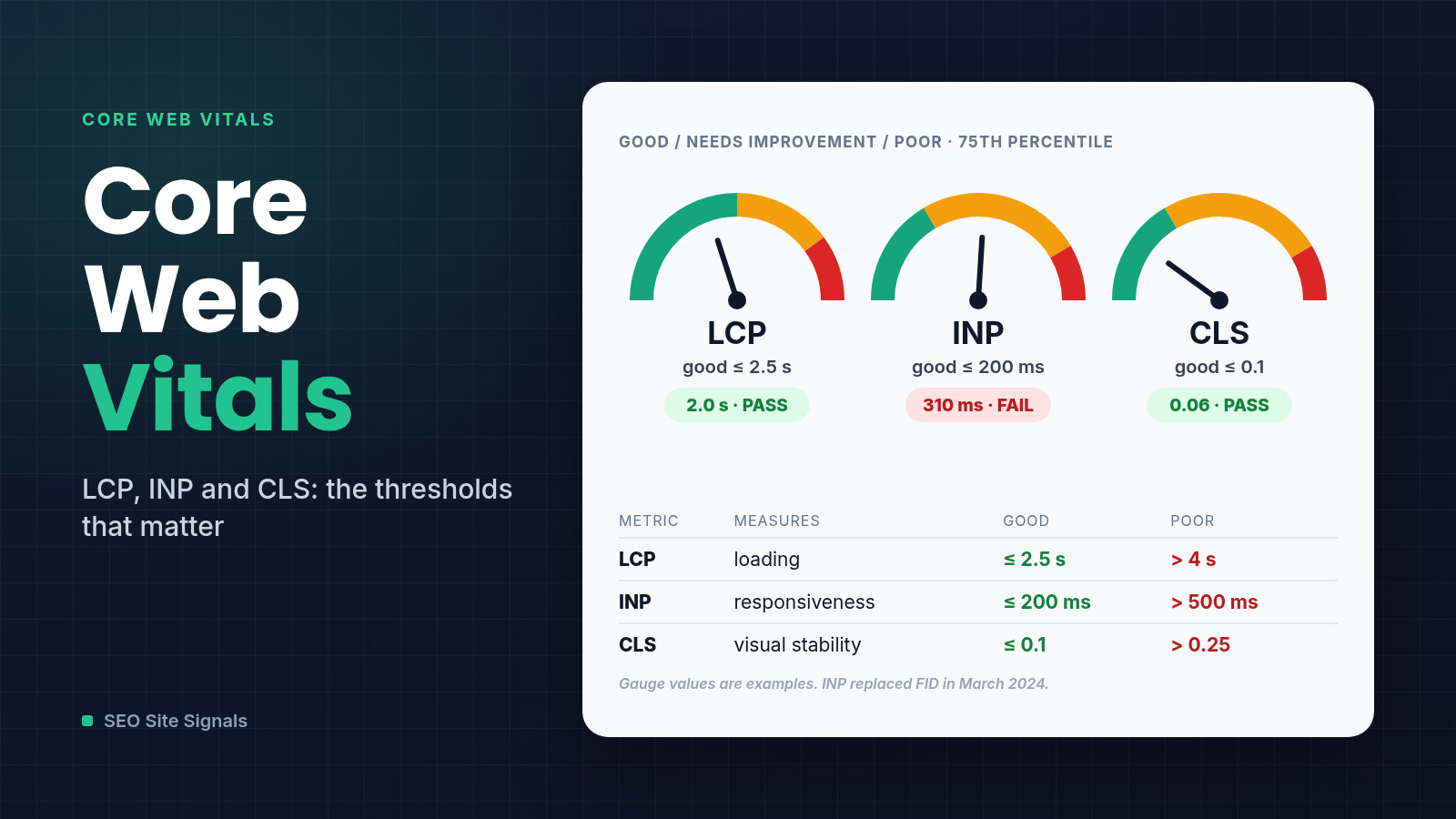
Core Web Vitals are three metrics Google uses to measure real-world page experience: Largest Contentful Paint (LCP) for loading, Interaction to Next Paint (INP) for responsiveness, and Cumulative Layout Shift (CLS) for visual stability. A page passes when, at the 75th percentile of real visits, LCP is 2.5 seconds or less, INP is 200 milliseconds or less, and CLS is 0.1 or less. INP replaced First Input Delay (FID) as a Core Web Vital on March 12, 2024, so any guide still listing FID is out of date.
This page is the reference: what each metric means, how Google collects the data, how much it matters for rankings, and where to go next for each fix.
What are the three Core Web Vitals and their thresholds?
The three Core Web Vitals each measure one part of how a page feels to a visitor. Google and web.dev publish the same thresholds, applied to the 75th percentile of page loads and measured separately for mobile and desktop.
Largest Contentful Paint (LCP)
Measures: When the largest image or text block in view has rendered
Good: ≤ 2.5 s
Needs improvement: 2.5 to 4.0 s
Poor: > 4.0 s
Interaction to Next Paint (INP)
Measures: How quickly the page visibly responds to clicks, taps, and key presses, across the whole visit
Good: ≤ 200 ms
Needs improvement: 200 to 500 ms
Poor: > 500 ms
Cumulative Layout Shift (CLS)
Measures: How much visible content moves unexpectedly
Good: ≤ 0.1
Needs improvement: 0.1 to 0.25
Poor: > 0.25
The 75th percentile matters. A page passes only if at least three out of four visits meet the threshold, so a fast result on your office connection says little about a customer on an older phone.
Why did INP replace First Input Delay?
INP replaced First Input Delay because FID only measured the delay before the browser started handling the first interaction. It ignored how long the response took to appear and every interaction after the first. INP observes interactions throughout the visit and reports one of the slowest, including the time until the next frame is painted.
In practice, many sites that passed FID easily found INP harder. Heavy JavaScript, large tag-manager setups, and complex menus or filters show up in INP in a way they never did in FID. If your team fixed "FID" in the past, check INP now.
How does Google measure Core Web Vitals?
Google measures Core Web Vitals with field data from the Chrome User Experience Report (CrUX), collected from real Chrome users who have opted in. Search Console and PageSpeed Insights report those numbers over a rolling 28-day window.
- Field data (CrUX, Search Console, PageSpeed Insights' top section) reflects what real visitors experienced. This is what Google's systems look at.
- Lab data (Lighthouse, lab-style tests) simulates one load on one device. It's ideal for debugging and for checking a fix straight away.
- Search Console groups similar URLs in its Core Web Vitals report, so one slow template can flag hundreds of pages at once.
- Low-traffic pages may not have enough field data. In that case, Google may fall back to data for a group of similar pages or the whole origin.
INP needs real interactions, so a lab test can't measure it directly. Total Blocking Time (TBT) is the usual lab stand-in: long main-thread tasks during load that would delay a response. The Total Blocking Time Test shows it for a live URL.
How much do Core Web Vitals affect rankings?
Core Web Vitals matter, but relevance matters more. Google says it "highly recommend[s]" good Core Web Vitals and that they align with what its core ranking systems seek to reward. Google's page experience documentation also says Search "always seeks to show the most relevant content, even if the page experience is sub-par," and that great page experience can contribute to success when many pages are similarly helpful.
Treat Core Web Vitals as a way to avoid losing close contests and to keep visitors who do click, not as a shortcut past better content. Claims that fixing them guarantees a set percentage of ranking or traffic growth aren't supported by anything Google has published.
Which Core Web Vital should you fix first?
Fix whichever metric Search Console reports as poor on your highest-traffic template, starting with mobile. If more than one fails, the usual order is LCP, then CLS, then INP. LCP and CLS fixes are often template-level changes, while INP work usually means reducing JavaScript.
If this fails: LCP
Usual causes on small-business sites: Large or lazy-loaded hero image, slow server, render-blocking CSS and JS
Where to start: Find the LCP element, and if first paint is also slow, fix FCP first
If this fails: CLS
Usual causes on small-business sites: Images without dimensions, late banners and cookie bars, web fonts, embeds
Where to start: CLS after a deploy and the Cumulative Layout Shift Test
If this fails: INP
Usual causes on small-business sites: Heavy themes and page builders, many third-party tags, slow menus and filters
Where to start: Reduce and defer JavaScript; check TBT in the lab, INP in the field
How do you monitor Core Web Vitals over time?
Monitor Core Web Vitals by checking the Search Console report monthly and after every significant release, and by running lab tests on key templates whenever the theme, plugins, or tags change. Regressions usually arrive with a small addition, such as a new widget, banner, or tracking tag, rather than a redesign.
- Check the Core Web Vitals report in Search Console, mobile first.
- Open the failing URL group and test one example URL in the lab.
- Fix the template, deploy, and confirm the improvement in the lab test.
- Click "Validate fix" in Search Console and allow up to 28 days for field data to catch up.
Core Web Vitals FAQ
What are the current Core Web Vitals?
The current Core Web Vitals are Largest Contentful Paint (LCP), Interaction to Next Paint (INP), and Cumulative Layout Shift (CLS). INP replaced First Input Delay (FID) on March 12, 2024. Good thresholds are 2.5 seconds for LCP, 200 milliseconds for INP, and 0.1 for CLS, at the 75th percentile.
Is First Input Delay still a Core Web Vital?
No. First Input Delay was retired as a Core Web Vital on March 12, 2024, when Interaction to Next Paint replaced it. FID only measured the delay before the first interaction was handled, while INP measures responsiveness across all interactions during a visit.
Why does PageSpeed Insights show different numbers from Search Console?
PageSpeed Insights shows field data for a single URL or origin at the top, and a lab Lighthouse run below it. Search Console groups similar URLs and reports field data for the group. Lab and field numbers often differ because the lab test uses one simulated device and network.
Do Core Web Vitals matter for low-traffic sites?
They matter for visitors on any site, but low-traffic pages may not have enough Chrome field data to appear in Search Console's report. You can still test them in the lab and fix obvious problems. Google may use data from similar pages or the whole site when a page lacks its own data.
How long do Core Web Vitals fixes take to show?
Lab tests show the change immediately. Field data in Search Console and PageSpeed Insights uses a rolling 28-day window, so improvements can take up to four weeks to be fully reflected. Search Console's validation process tracks this for the affected URL group.
See every performance check in one place: the SEO Site Signals tools index groups the LCP, CLS, TBT, and speed tests so you can test the metric that is actually failing.
Related guides: testing INP with Total Blocking Time, and whether a CDN is making your pages faster.
SEO Site Signals is the free-tool and monitoring product from PositionMySite, a North American software company in Toronto and Tampa. We have been building web software since 2009, and our in-house engineers build the Core Web Vitals checks on this site and the paid dashboard that tracks them over time. The free tests are there so a small team can find the failing metric before buying an enterprise performance suite.
Last updated: September 25, 2026 | Author: David Dayan | Sources: Google Search Central, "Understanding Core Web Vitals and Google search results"; Google Search Central, "Understanding page experience in Google Search results"; web.dev, "Web Vitals"; web.dev, "Interaction to Next Paint becomes a Core Web Vital on March 12"; web.dev, "Interaction to Next Paint (INP)"; Search Console Help, "Core Web Vitals report".